
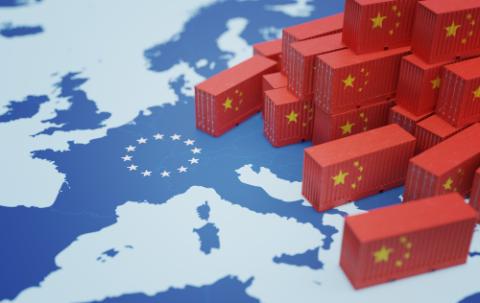
The EU is looking to rebalance trade relations with China
Cora Vandamme, senior economist KBC
Although strong and impressive, trade relations between the EU and China are out of balance, putting a strain on the relationship. The EU seeks to set boundaries but has opted for a diplomatic approach, emphasising cooperation and communication.
The robust reciprocal trade relations between the EU and China involve sizeable flows of goods and services in both directions. Still, the relationship has come under increasing pressure in the past few years. When China was still the world’s factory and mostly produced low-value-added goods, it posed only a minor threat to the EU economy.
Recently, however, China has transformed its industrial policy by shifting its focus to the development and manufacture of high-tech goods. This is putting pressure on relations between the two great powers now that China has entered into direct competition with major EU industries. At the same time, the Chinese market remains heavily shielded from foreign manufacturers and investors. The EU is also increasingly concerned about China’s strategic dominance, partly owing to Europe’s substantial dependence on China for critical materials needed for the digital and energy transitions. The EU is currently exploring ways to redress the trade imbalance with China without shooting itself in the foot; China has already clearly stated that it will respond with countermeasures if the EU takes action.
The EU takes this threat seriously, as is apparent from the cautious stance adopted following the meeting of European leaders in June. The meeting did not produce a large-scale plan to implement trade measures, but rather a request to the European Commission to explore what instruments can be used to tackle diverse global trade threats (unofficially mainly China’s industrial overcapacity). While the EU clearly intends to reinforce its trade and industrial policies, it still stresses that communication and cooperation remain the foundations of its relations with other countries, including China.
The EU is flooded with Chinese goods
The EU’s goods trade deficit with China has grown significantly since the 2000s. This is a logical development, given that economic activity in emerging economies typically outpaces economic activity in developed economies. The major problem the EU is facing right now is that mainly exports from China have surged – and increasingly so in economic sectors that are important for the EU – while imports are failing to keep pace.
China’s middle class has expanded spectacularly, but this group’s spending is not increasing at the same rate, which is partly due to the country’s ongoing real estate crisis and its limited social safety net. Chinese consumers are keeping a tight hold on their purse strings and manufacturers are struggling to sell enough of their products in the domestic market. The oversupply of certain products was also exacerbated by the government’s market-distorting investment policy, which resulted in overproduction as strategic goals and local interests were given priority. This overproduction is, in turn, increasingly forcing Chinese manufacturers to find markets abroad. The more hostile trade policy of the US under Trump made matters even worse and pushed Chinese exporters further towards the EU.
The EU intends to set boundaries
The EU is seeing its industry being outcompeted by Chinese imports on an ever greater scale while the EU’s dependence on China is growing. Factors complicating relations with China include asymmetries between the openness of the Chinese and EU markets, as well as restrictions on the free movement of the Chinese currency.
Additional measures to slow down these developments are increasingly advocated in the EU. Good reasons to introduce such measures range from protecting employment to safeguarding European geopolitical and economic independence. Warnings about the strategic risks associated with the large share of Chinese components and software in key EU infrastructure are also becoming more and more frequent.
The EU has already launched numerous initiatives to diversify imports and protect the internal market more effectively, partly to curb the import of oversubsidised goods. A few initiatives include the Critical Raw Materials Act, the Industrial Accelerator Act, the Cyber Security Act, the Net-Zero Industry Act and the removal of the de minimis exemption for e-commerce shipments below 150 euros from third countries.
Circumvention and retaliation
For some time now, the EU has been suspicious of China’s alleged attempts to circumvent EU protective measures. For example, doubts have arisen as to the rationale for China’s multi-billion-dollar investments in Morocco, since a comprehensive free-trade agreement is in place between Morocco and the EU. The EU fears that these investments are intended at least in part to ship overproduction from China to the EU through Morocco, without any substantial added value being created in Morocco – while this is in fact an important condition for products to be covered by the trade agreement and exported to the EU at zero tariffs (in compliance with the rules of origin).
China is also becoming less and less reluctant to use strong language and take firm action to prevent other countries from tightening their trade policies. A case in point here is the rapidly escalating tit-for-tat accumulation of tariffs and export restrictions between the US and China in 2025. China has an extensive range of trade measures at its disposal to protect its own interests, including imposing import levies or restrictions. At the start of this year, China warned that the country would launch anti-dumping and anti-subsidy investigations into goods from the EU, including French wine, if the EU were to take trade measures against China. Surpassing the importance of the import instrument is China’s ability to restrict the export of critical materials for the climate and technology transitions or to halt it altogether.
The EU is keeping the lines of communication open
In view of all this, it is hardly surprising that the June 2026 meeting of European leaders on this issue did not result in a long list of new tariffs, quotas and trade restrictions. Still, the meeting was not in vain. The European Commission has now been instructed to explore what measures the EU can take to reduce the ‘untenable’ trade deficit with China, although the EU remains committed to communication and cooperation in this matter. In this context, a new consultation forum between the two power blocs – the EU-China Trade and Investment Consultation (TIC) mechanism – was announced a few days ago. This implies that the EU has opted for velvet-glove diplomacy for now, rather than immediately resorting to iron-fist measures.
Disclaimer:
Unless expressly stated otherwise, all information that you consult or obtain here has a non-binding and purely informative value. It is updated to the best of its ability and at regular intervals. However, KBC Bank NV does not guarantee the topicality, accuracy, correctness, completeness or suitability for a particular purpose of this information. The information provided here does not constitute advice or offer to sell products or services and is not intended for commercial use. You remain fully responsible for the consequences of the use you make of this information. The intellectual property rights to the information, publications and data provided here belong to KBC Bank NV or to third parties and you must refrain from any infringement thereof. Except with the express prior written consent of KBC Bank NV, any transmission, sale, distribution or reproduction of this information is prohibited.