


AI’s appetite for computing power is straining the grid
The rise of artificial intelligence (AI) is driving demand for computing power. However, AI data centres are being built faster than they can be connected to the grid, making power a crucial bottleneck. At the same time, new opportunities for investors are emerging at the intersection of technology, energy and infrastructure.
Computing power is the driving force behind our digital economy and society. Especially in the United States, large data centres – basically supercomputers providing computing power – are springing up at a rapid pace. “The demand for computing power far exceeds supply”, says Joris Franck, Portfolio Manager and Technology Expert at KBC Asset Management.
The demand for computing power has been rising for decades: more powerful chips enable new applications, which in turn drive demand. “AI has now turbocharged this demand. It’s as if, instead of cars, we now all of a sudden have lorries driving on the same digital motorway.”
Capital and power

Building more data centres is not such a simple solution. “AI data centres are extremely capital-intensive and technically complex. Each new data centre pushes the boundaries of what is possible”, says Franck. “Moreover, they are fundamentally different from their predecessors. Traditional data centres run primarily on CPUs (Central Processing Units) and support applications such as websites, streaming and cloud software. AI data centres are built to train and utilise AI models.”
That difference is also reflected in the hardware. “AI data centres run primarily on GPUs (Graphics Processing Units) or AI accelerators. Engineers are making hundreds of thousands of GPUs work together in a single cluster, which could soon be millions. A million GPUs can easily cost 30 billion dollars. And that doesn’t even include the building, the power supply and the rest of the infrastructure.”
The physical scale of that infrastructure is mainly reflected in the energy demand. “The largest AI data centres are designed to continuously consume around one gigawatt”, says Jonas Theyssens, Portfolio Manager and industry expert at KBC Asset Management. “That’s about 24 gigawatt-hours a day, roughly equivalent to the daily consumption of some 750 000 households.”
“In the US, for the first time in about 15 years, we’re seeing a clear increase in electricity demand again”, says Theyssens. “The combination of the electrification of cars and heat pumps, and of data centres as a new major consumer, is pushing demand structurally higher.” Yet, according to Theyssens, the root of the problem does not lie in an absolute power shortage. “The fundamental problem is that electricity is a physical product that must be supplied locally and continuously. You can’t just move power around. And that is precisely where the problem lies: data centres are concentrated in specific regions and demand enormous amounts of power all at once.”
The digital world thinks in quarters, the electricity world in years or even decades. Without a connection, even the most advanced data centre remains an empty box.
Jonas Theyssens, Portfolio Manager and industry expert at KBC Asset Management
The result is a bottleneck in the electricity grid. “Historically, the grids aren’t built for such heavy and concentrated loads, let alone for the pace at which new projects are rolled out. This makes time-to-power crucial. A data centre can be built relatively quickly, in about one and a half to two years, but accessing power takes much longer. In some regions, waiting times for grid connection can be as long as seven years. The digital world thinks in quarters, the electricity world in years or even decades. Without a connection, even the most advanced data centre remains an empty box.”
Possibilities for investors
Meanwhile, the next driver of demand is already on the horizon. “AI agents easily consume ten thousand times more computing power than a chatbo”, says Franck. “This involves software that performs tasks autonomously by controlling underlying AI models. These models process instructions and information as tokens: small pieces of text or data. Reports are already circulating of companies consuming their entire annual token budget in just a few months. In some cases, an AI agent can even end up being more expensive than a human employee.”
In some cases, an AI agent can even end up being more expensive than a human employee.
Joris Franck, Portfolio Manager and Technology Expert at KBC Asset Management
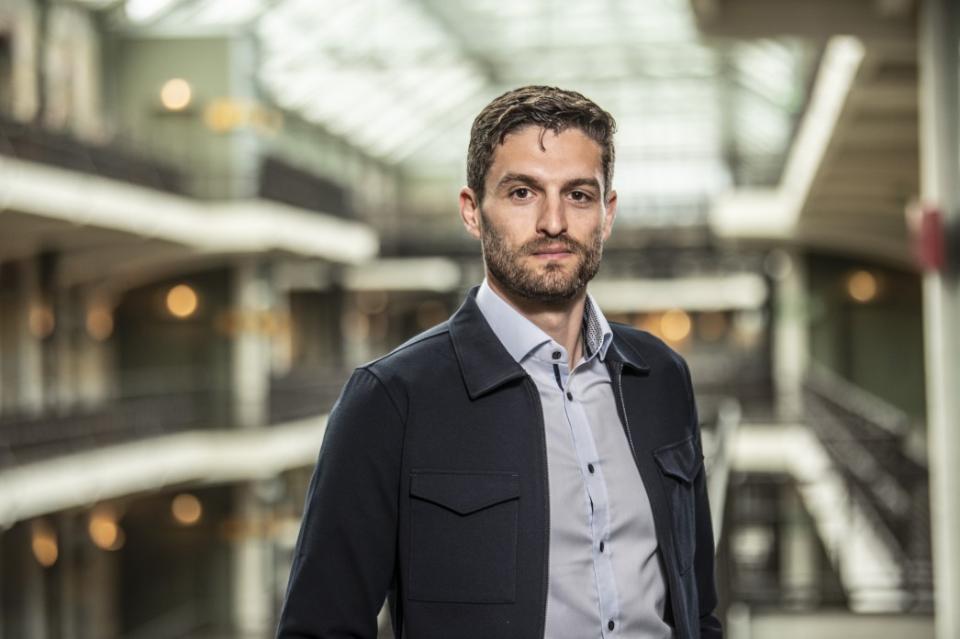
For investors, this opens up a broad playing field, but also a complex landscape. The opportunities are not limited to technology companies, but extend across infrastructure, energy and industry. “The question is not so much ‘Who will win the AI race?’ but ‘What is required to make that growth possible in the first place?’ That is why, now more than ever, diversification is not a luxury but a necessity. In our thematic funds, we take a broad approach to the theme, closely monitor developments and deliberately build exposure across different sectors and perspectives”, Theyssens concludes.
Want to learn more about thematic investing?
This document is a publication of KBC Asset Management NV (KBC AM). The information and figures it contains are a snapshot, which may be changed without notice. The information provided offers no guarantee for the future. The information provided should not be regarded as investment advice or as an investment recommendation. Nothing in this document may be reproduced without the prior, express, written consent of KBC AM. This information is governed by the laws of Belgium and is subject to the exclusive jurisdiction of its courts.